About
My photo equipment
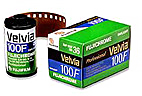 I admit it—denial is futile: I belong to that breed of people who have completely succumbed to the brilliant luminosity of a perfectly exposed slide, and Velvia is the preferred target of my photographic endeavors! Its color saturation and sharpness are remarkable—and have long since become legendary. Perhaps that makes me a romantic, but photographs do not become better simply because one employs a different technique. Case in point:
If one calculates very conservatively, assuming a resolving power of just 55 line pairs per millimeter, this yields 55 Lp x 36 mm = 1,980 Lp along the long edge of the image; consequently, 3,960 pixels are required to resolve them (since two pixels are needed to represent a single line pair—that is, one black and one white bar). Canon's former flagship models, the EOS 1Ds Mark III and the EOS 5D Mark II, feature sensors with 5,616 pixels along their long edges. Taking the Kell factor into account, we can expect these sensors to deliver effective resolution values of 3,744 Lp (this reduction stems—to put it simply—from the fact that the bars of the test patterns do not always align precisely with individual pixels, but frequently fall between them instead). — Thus, silver-based film still holds its own remarkably well by comparison!
Moreover, simply swapping out the camera body is not enough. To fully harness the potential of digital image sensors, one requires specially designed lenses featuring an optical path that ensures light rays strike the photosensitive surface as perpendicularly as possible at every point.
Furthermore, a digital image remains, by its very nature, a reflection of the medium used to display it; its quality rises and falls with that of the output device. The colors of a slide, by contrast—when viewed under daylight—represent fixed, objective values against which anyone can orient themselves at any time. Another advantage lies in the archival longevity of an exposed piece of film. The odds are quite good that, many years from now, one will still be able to scan it using the most advanced technology available at the time and produce a print. But who knows whether the file formats currently in use will still be readable by then? Thus, for me, analog technology remains the ultimate standard.
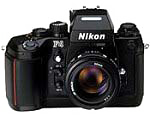 My recording device of choice is the Nikon F4—a camera that, while aged, remains remarkably robust. I settled on this model several years ago, following my departure from the Canon system, because it combines features that are otherwise hard to come by within a build so sturdy you could literally drive nails with it: compatibility with both MF and AF lenses; matrix metering with AI-S and AF lenses (a capability not seen again until the F6—where, incidentally, it is more complicated to operate); automatic fill-flash with manual adjustment capabilities when paired with the SB26 flash unit; a true 100% viewfinder; and the ability to lock the eyepiece. I am particularly grateful for the latter feature—as well as for the battery-saving "T" exposure mode—especially during extreme long-exposure photography.
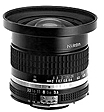 A Nikkor 3.5/18mm MF for relatively distortion-free super-wide-angle shots. It is a sheer delight to get right up close to a foreground subject with it, thereby making it appear massive in the frame.
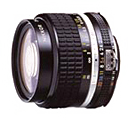 A Nikkor 2.8/24mm MF, which I value for its sharpness and brilliance. A Nikkor 2.8/28mm MF from the Series E. This affordable and lightweight lens boasts astonishing imaging characteristics and a warm color rendition that I find very pleasing.
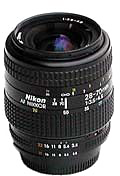 A Nikkor 3.5–4.5/28–70 mm AF D. This slightly slower variant covers the most frequently used focal length range, thereby serving as an all-purpose lens. Additionally, it enables matrix-controlled fill-flash photography that takes distance into account.
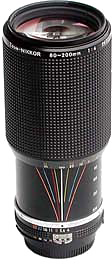 The Nikkor 4.0/80–200mm MF bridges the optical gap into the telephoto range—and, in conjunction with the Nikon TC-200 2x Teleconverter, extends a good deal beyond it.
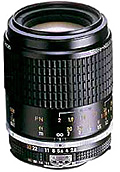 The Micro-Nikkor 2.8/105mm MF is, ultimately, the tool for those delicate little still lifes waiting to be discovered along the roadside in any landscape. Its imaging performance—optimized for close-up work—ensures perfect sharpness, even in the finest details.
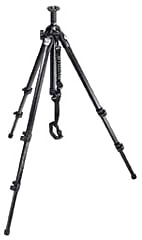 Speaking of sharpness: naturally, this is often impossible to achieve without a tripod. My compromise between stability and weight is the Manfrotto 055 C. A robust ball head—the FLM CB 38—ensures a slip-proof connection to the camera. Once set to the correct friction, even the heaviest camera-lens combination glides on it like silk!
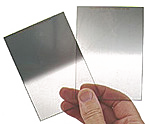 Aside from the obligatory odds and ends—such as a cable release, right-angle finder, and UV and polarizing filters—there remains one important technical accessory to mention: a set of Singh-Ray graduated neutral density filters, in strengths of -2 and -3 stops, featuring either a hard or soft transition between the gray and clear areas. Without this equipment, many high-contrast landscape scenes simply cannot be captured on film.
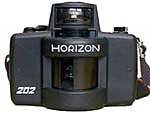 So much for the 35mm format. But, of course, one can go a little bigger still. I take photographs—rather than shoot video—because I think in terms of individual images, not sequences. And because my visual perception is wide, much like CinemaScope, panoramas are my passion. One way to indulge this passion is by working with the Horizon 202. What appeals to me about it is the simplicity and reliability of its construction (I know, others have had different experiences!) as well as the dynamic barrel distortion that occurs when the camera is not aligned exactly horizontally. Another path to the ultra-wide format is the digital stitching of individual 35mm shots. In this process, it is crucial that the exposure is averaged across all the images and that the camera is mounted on two sliding rails arranged in a cross configuration—after all, it really ought to rotate around its optical axis!
Ultimately, however, the choice of equipment is a purely subjective matter; what matters is not *what* you use to take photographs, but simply that you do it! In this sense, the camera and accessories should serve only one purpose: to realize your creative vision as effectively as possible.