
Nature Science+Photography Volume2: Lightness and Color
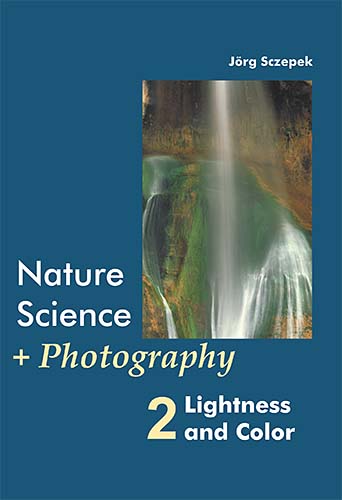
This second volume in the series Nature Science+Photography explores the visual and technical foundations of lightness and color:
How do we perceive brightness and color?
Why do we perceive our environment in color?
Does a colorful world exist independently of us?
How do we reproduce impressions of brightness and color?
Why is color management necessary, and how does it work?
How do photographic media generate brightness and color?
What insights can we derive from the workings of the visual system to inform image composition?
The first chapter explores how our visual system generates the perception of brightness and color, how the necessary data is processed at various stages, and how, ultimately, these inputs coalesce into integrated impressions. By the end of this chapter, we are compelled to recognize that brightness and color do not exist independently of us; rather, they are purely constructs of our mind—constructs that enable or simplify our survival within a complex environment.
Chapter Two addresses the fundamentals of the technical reproduction of brightness and color perceptions, the various methods used to describe them, and the color management principles derived therefrom. Conclusion: Brightness and color perceptions can be reproduced by stimulating the visual system with a stimulus that, in its totality, corresponds to the original—though it need not be spectrally identical.
Chapter three explores how analog and digital photographic media generate brightness and color, and what conclusions regarding photographic image composition—specifically the use of brightness and color values—we can draw from physiological realities. Furthermore, it addresses the role of lighting quality—specifically, the fact that while our visual system is largely immune to changes in the spectral composition of illumination, such changes must indeed be taken into account in photography, and it explains how this is achieved. The final section examines the factors we must consider during the shooting phase in order to satisfy a frequent desire among viewers: increased color saturation.
But to state it right up front: Science has not yet answered all the questions surrounding this complex subject, and here and there, it still leaves us all waiting for a few answers. Yet, what remains unexplained at least serves to sharpen our sensitivity to the matter!
Order your copy
Content
Introduction 5
1. The perception of lightness and color
Determining the origin of lightness and color 8
Determining the physiological input stage 10
The eye 10
The retina 13
The photoreceptors in general... 13
…and the cone receptors in particular 15
First processing stage: Categorization of information 18
Second processing stage: Conversion of signals into opponent color channels 21
Like on TV: The reason for the complicated procedure 28
Third processing stage: Adding a spatial aspect for color 29
Approximate color constancy does not mean complete color constancy 35
Fourth processing stage: Generation of impressions 37
Red is better than blue: Our preference for warm colors 39
Not yet answered: The question of why 41
2. The reproduction of lightness and color
Basics of reproduction 46
The additive mixture 46
The subtractive mixture 47
The relationship between the additive and subtractive primary colors 48
RGB, CMYK: Description of impressions in device-dependent reference systems 49
CIE-Lab: Description of impressions in device-independent reference systems 51
Color management: The perception algorithms of machines 57
Metamerism: Two colors in different light 62
3. Lightness and color in photography
Three color separations 66
Analog image carriers: Negative film 66
Analog image carriers: Reversal film 68
Electronic image carriers and digital technology 69
Where and What: Lightness and color in image design 74
Opponent color combinations in image composition 76
Complementary contrast 77
Light-Dark contrast 78
Cold-Warm contrast 79
Color in itself contrast 80
Simultaneous contrast 80
Quality contrast 81
Quantity contrast 82 Constancy excluded: The role of lightning quality 83
Analog temperature correction 84
Digital temperature correction 88
Frequently requested: Stronger color saturation 90
Shooting time 91
UV filters 91
Light reflection and light scattering 93
4. Appendix 98
Jörg Sczepek
Nature Science+Photography
Volume 2: Lightness and Color
6.69x9.61" / 17x24.5 cm
90 color images, 136 pages, 12.99 $
ISBN 9798248956739
Independently published
Available at your local amazon store