
Nature Science+Photography Volume 5: Natural Light
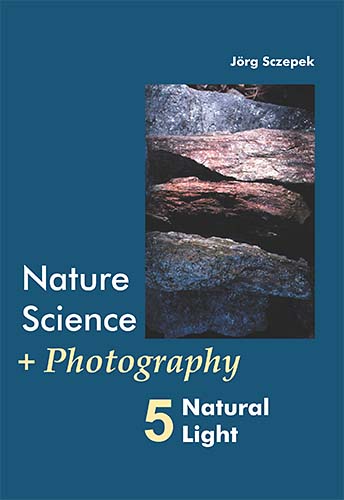
Volume 5 of the Nature Science+Photography series explores light—the fundamental element of photography:
What is light?
How can we describe and generate it?
What is its relationship to the Sun—our primary source of light?
What are the underlying principles behind the atmospherical light phenomena that are significant to photography?
What must we consider when capturing the Moon as a subject, or utilizing it as a light source?
How can we photographically capture the stars?
How can we harness astronomical conditions to achieve the best possible lighting?
The first chapter explains that while we can describe light—the driving force behind our vision and photography—as a specific segment of the electromagnetic spectrum, we still do not know with certainty exactly what it is—whether wave or particle—despite, or perhaps thanks to, quantum theory.
The second chapter examines the astronomical and geometric relationships between the Earth and the Sun, our primary source of light. Specifically, it elucidates how the seasons come about and why the duration of day and night varies throughout the year.
The third section introduces the atmospheric light phenomena of greatest significance to photography: Mie scattering, which accounts for the appearance of nearly white haze; Rayleigh scattering, which creates the blue of the sky; the combined scattering phenomena observed at sunrise and sunset; and the refraction phenomena responsible for atmospheric bending and rainbows.
The fourth chapter is dedicated to the Moon. The first part presents La Luna as a photographic subject, explains all the factors regarding the lunar orbit that are relevant in this context, and offers guidance on image composition. The second part introduces the Moon as a light source in the context of night photography and details all the specific aspects of significance in this regard.
In creative photography, the luminous points in the night sky—commonly referred to as stars—play a pivotal role, whether captured as distinct points of light (pinpoint stars) or as streaks (star trails). Both of these subjects are the focus of Chapter Five.
Chapter Six explores how we can harness astronomical and geometric conditions—specifically those involving the Sun, Moon, and stars—to serve our creative photographic concepts. In other words, it examines the tools and methods that allow us to calculate in advance precisely what kind of light to expect, and where and when to expect it.
Order your copy
Content
Introduction 5
1. The light - Fuel of visuality
The elctromagnetic radiation and its spectrum 8
Description of the intangible - Wave or particle 9
With the grain or against it - The polarization of electromagnetic radiation 11
Generating light - More than just flicking a switch 14
2. Earth and Sun - Relationships with our light-giver
Geometrical basics or why 1+1 equals 23 ½ 18
The seasons 19
The different legths of day and night 22
3. Light phenomena in the atmosphere
Scattering phenomena 26
Uniform scattering of light to nearly white - The Mie scattering and haze 26
Uneven scattering of light to (almost) a single color - The Rayleigh scattering and the sky blue 29
Special case low sun position - The combined scattering of light produces the most vibrant colors 32
The twilight phenomena 34
Refraction phenomena in the atmosphere 40
Atmospheric refraction - The stars are lower than we think 40
Rainbows - The full spectrum of colors 41
4. The Moon - Our companion through the night
The moon as a motif in the picture 44
First, the geometry 44
The lunar orbit - High in the sky it should stand... 46
Moonrise and moonset - ...and rise and set on time 47
Phases of an orbit 49
Geometry alone does not make a good picture 52
The moon as a light-giving object 56
The equipment 57
Technique and design 57
Light equals brightness 59
5. The stars - Too many dots to count
The earth is no star 64
Pinpoint stars 64
Preparatory calculations and little astronomy 64
Startrails 69
Exposure and technique 70
Not all arcs are the same - Appearance and design of the startrails 72
Creative approaches and a bit of cheating 76
6. How we can make geometry work for a good photo
Astronomy as a service provider 78
The compass 78
The clinometer 81
We orient ourselves to a real place in front of us 83
We orient ourselves to a place on the map 84
The electronic helpers 84
7. Appendix 88
Jörg Sczepek
Nature Science+Photography
Volume 5: Natural Light
6.69x9.61" / 17x24.5 cm
60 color images, 101 pages, 12.99 $
ISBN 9798248956739
Independently published
Available at your local amazon store